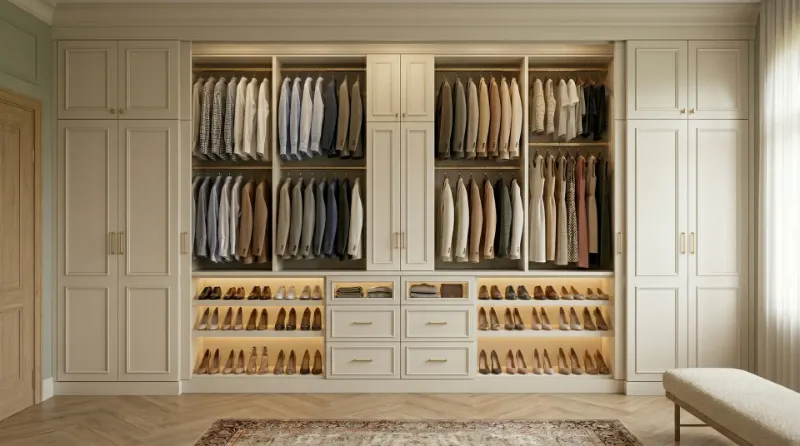
Most reach-in closets waste half their volume on a single rod and a dusty shelf. The instinct is to blame the room — too shallow, too narrow, too small for real storage. The actual problem is almost never the footprint; it's that a single rod and one shelf only use one dimension of a three-dimensional box. The fix is not more closet — it is using the closet you already have in three dimensions instead of one, and it's the same discipline we apply whether the closet is three feet wide or thirty.
The single highest-yield change
Double the rod. Long-hang on one side for anything that needs full length, two stacked rods on the other at roughly 42 and 82 inches, instantly doubles hanging capacity and costs nothing in floor space. It is the first move on every compact closet we design, and it alone typically recovers what most people assume they'd need a bigger room to get. The only caveat: measure your longest folded-over garment before setting the lower rod height, or a stack of trousers ends up dragging the floor.
Then go vertical everywhere else
A shallow reach-in closet is usually six to seven feet tall but only used up to about five feet — the space above eye level goes untouched simply because nothing was built to organize it. Close that gap:
- Shelf dividers keep stacks from toppling into each other, which is what actually causes the "avalanche" every time you pull one sweater from the middle of a pile
- Pull-out baskets replace the pile that forms on the floor for shoes, gym bags, or anything too irregular to stack
- Door-back racks carry belts, scarves, ties, and shoes that would otherwise claim a shelf — a standard closet door can absorb a genuinely surprising amount of accessory storage for zero interior footprint
- An upper cabinet with a fixed shelf captures the top eighteen inches for out-of-rotation items, instead of leaving it as dead air above the rod
The single mistake that undoes all of it
Buying more hangers. It sounds counterintuitive, but a compact closet's real enemy is volume, not organization gadgets — every extra hanger is another two inches of rod space claimed by something that may not earn its place. Before adding storage, subtract: a genuine edit, done once, does more for a small closet than any accessory purchased afterward.
Finally, edit by season
A compact closet holding only the current season feels twice its size, because half the volume genuinely isn't competing for the same rod at the same time. Send the rest to an upper cabinet, a vacuum-sealed bag on a high shelf, or an under-bed drawer until the weather turns — in Florida that's a short list to begin with, which makes this particular trick even more effective here than almost anywhere else. For the full anatomy of a hard-working compact closet, including how we handle the built-in version of every idea above, see our reach-in closet page.